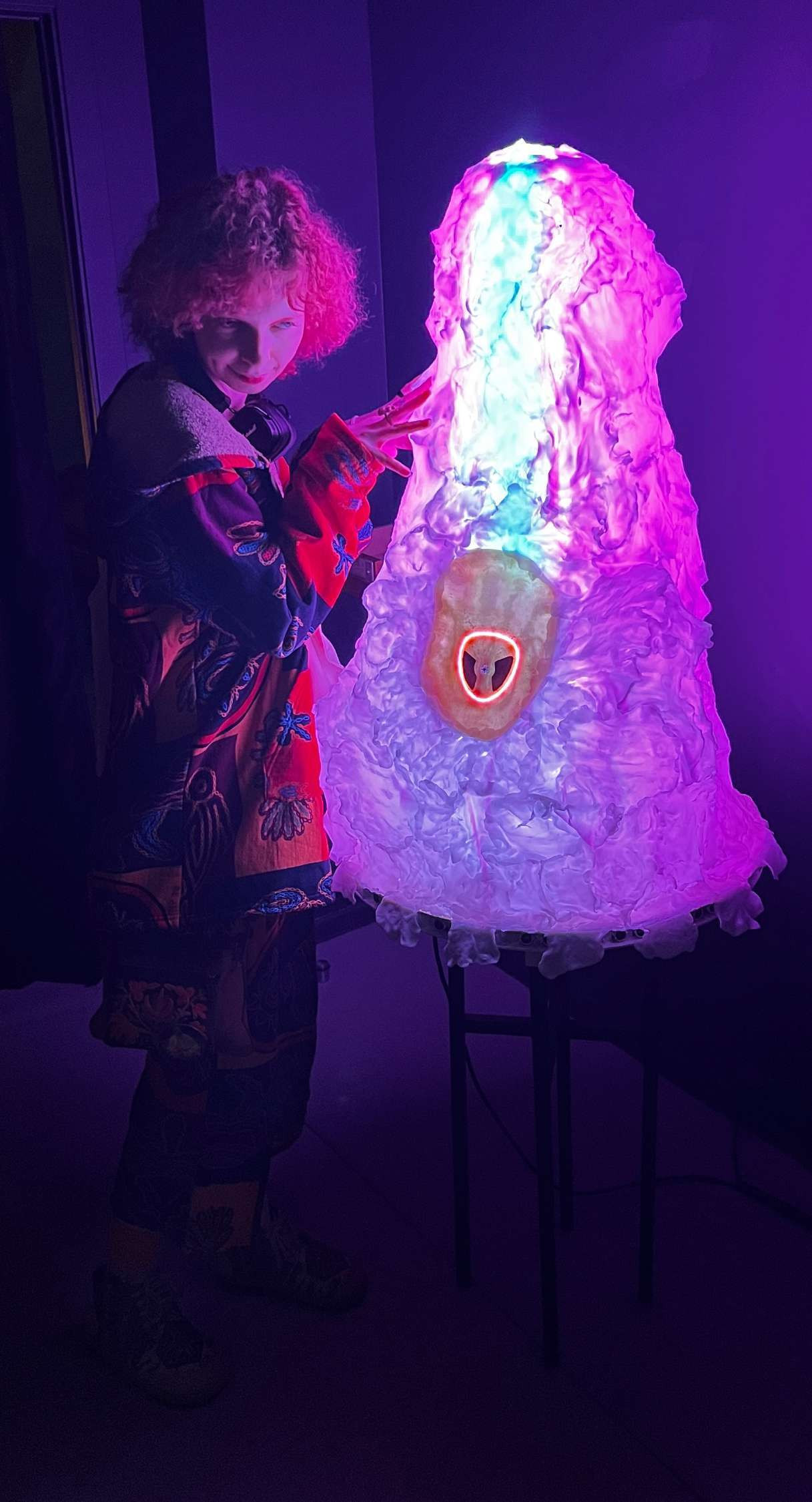
The Stone of (Complementary) Permission
Artwork details
Polina Zhadko · 2024–2025
Interactive installation
About the work
A shy person often needs an additional permission to act — both for themselves and for the person they are interacting with. In many cases, a shy individual struggles to express either their discomfort with communication or their desire to initiate it.
The Stone of Permission offers one possible solution to this interpersonal dilemma. The stone emits a sound, inviting interaction. As someone approaches, the sound softens, demonstrating a kind of "responsiveness" to the potential participant.
A sensor embedded in the stone's surface measures the person's pulse when they place their hand on it. After recording the heart rate for one minute, the stone glows green. This green light serves as a signal of permission for others, indicating the person's readiness and willingness to engage in dialogue.
If another person then approaches and the conversation causes discomfort, the green light turns red, signaling a prohibition and suggesting that the dialogue should not continue.
Thus, the artwork introduces an external signal — "permission" — as a tool for communication. From the interlocutor's perspective, the stone displays either a clear permission to engage or a clear prohibition.
The work refers to Niels Bohr’s principle of complementarity: different experimental arrangements reveal complementary aspects of quantum phenomena. The installation adapts this idea to the relationship between a person, an encounter and its context.
It is interesting to note that Bohr himself was inspired by the works of psychologist William James, who used the term "complementarity" to describe mutually exclusive relationships. This installation translates this idea from the quantum realm into the realm of human interaction.